






 Settings
 Fast Delivery
 Free Shipping
 Incoterms
 Payment Types


 Marketplace Product

MEMS versus ECM: Comparing Microphone Technologies
2019-02-21
From wearables to home assistants, increasing numbers of devices utilize microphones to accurately capture almost any sound. Two of the most commonly used technologies in microphone construction are micro-electro-mechanical system (MEMS) microphones and electret condenser microphones (ECM), with numerous use cases for either one. This article will review the basics of both technologies, compare their differences and run through the advantages of each solution.
MEMS microphones
Built with a MEMS component positioned on a printed circuit board (PCB) and protected by a mechanical covering, MEMS microphones have a small hole machined in the case that allows sound into the device. The positioning of this hole defines whether the microphone is designated as top-ported, if the hole is in the top covering, or bottom-ported, if located in the PCB. MEMS components often have a mechanical diaphragm and a mounting structure fabricated onto a semiconductor die.
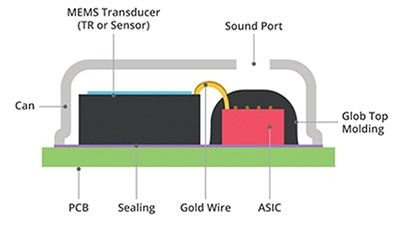
Figure 1: Typical top-port MEMS microphone construction. (Image source: Same Sky)
The MEMS diaphragm forms a capacitor and sound pressure waves cause movement of the diaphragm. Generally, MEMS microphones contain a second semiconductor die acting as an audio preamplifier which converts the MEMS’ changing capacitance to an electrical signal. Where an analog output signal is preferred, the output of the audio preamplifier can be provided to the user. However, if a digital output signal is required, an analog-to-digital converter (ADC) is incorporated on the same die as the audio preamplifier. Pulse density modulation (PDM) is the conventional format utilized for digital encoding in MEMS microphones and allows communication to take place with only a single data line and a clock. In addition, decoding the digital signal at the receiver is made easier owing to the single bit encoding of the data.
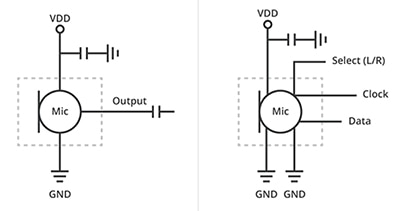
Figure 2: Left: application schematic of an analog MEMS microphone. Right: application schematic of a digital MEMS microphone (Image source: Same Sky)
Electret condenser microphones
Electret condenser microphones (ECM) are constructed as shown in Figure 3.
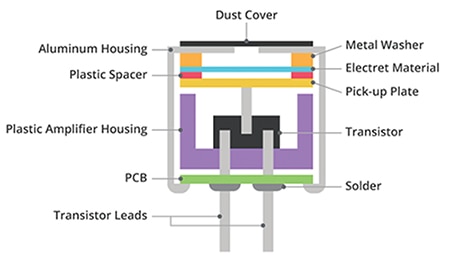
Figure 3: Basic construction of an electret condenser microphone (Image source: Same Sky)
In an ECM, the electret diaphragm is a material with a fixed surface charge that’s placed near a conductive plate, and, like a MEMS microphone, a capacitor is created with the air gap forming the dielectric. Sound pressure waves moving the electret diaphragm cause the value of the capacitance to change, causing voltage across the capacitor to vary, ΔV = Q/ ΔC (Q = a fixed charge). These variations in capacitor voltage are amplified and buffered by a JFET inside the microphone housing. The JFET is usually designed in a common-source configuration with an external load resistor and dc blocking capacitor employed in the external application circuit.
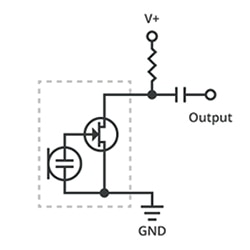
Figure 4: Application schematic of an ECM (Image source: Same Sky)
Advantages and trade-offs
When choosing between an ECM or a MEMS microphone, there are numerous considerations to take into account. The many advantages offered by the newer MEMS microphone technology are reflected in its rapidly expanding market share. For example, those looking for solutions in space-limited applications will look favorably on the small package sizes offered by MEMS microphones, as well as the reduction in both PCB area and component cost achieved with the inclusion of both the analog and digital circuits within the MEMS microphone assembly.
In addition, the comparatively low output impedance of analog MEMS microphones, together with the outputs from digital MEMS microphones, are perfect for applications in electrically noisy environments. Likewise, the use of MEMS microphone technology in high-vibration environments can reduce the level of unwelcome noise produced by mechanical vibration. Semiconductor construction technology together with the addition of audio preamplifiers further makes it possible to manufacture MEMS microphones with closely matched, temperature-stable performance characteristics, making them well suited for multi-microphone array applications. During the manufacturing process, MEMS microphones can also tolerate reflow soldering temperature profiles.
Despite the rise of MEMS microphones, electret condenser microphones remain a viable option for a variety of applications. With many legacy designs having used ECMs, continuing to use an ECM for simple design upgrades may provide the simplest solution for engineers. ECMs also give designers added mounting flexibility with termination types that include wires, pins, solder pads, SMT, and spring contacts. Where dust and moisture are an issue, it is easy to source ECM solutions with high ingress protection (IP) ratings because of their larger physical size. Furthermore, in applications that require non-uniform spatial sensitivity, ECM products exist with either unidirectional or noise cancelling directivity. Their wide-ranging operating voltages can also be ideal in applications with loosely regulated voltage rails.
Selecting the right microphone
Ultimately, your choice of microphone technology is dependent upon the constraints of your project. While it is no secret that MEMS microphones continue to grow in popularity due to their numerous intrinsic advantages, ECMs are still relied upon in a range of applications because of the variety of their packaging and directionality options. However, technology choices aside, electronic components manufacturer Same Sky continues to develop and offer a wide range of microphone products, giving you added flexibility when it comes to your audio needs.
Disclaimer: The opinions, beliefs, and viewpoints expressed by the various authors and/or forum participants on this website do not necessarily reflect the opinions, beliefs, and viewpoints of DigiKey or official policies of DigiKey.











 Singapore