Specialty Connectors Offer Automotive-Compatible USB-C Connectivity

作者:Bill Schweber

投稿人:DigiKey 北美编辑

The Universal Serial Bus (USB) Type-C connector has standardized and simplified connections between mass-market consumer devices. Designers of automotive systems can also benefit from using USB-C for high-speed, non-safety-related functions such as infotainment. However, conventional USB-C connectors tailored for consumer applications do not have the required ruggedness, reliability, and safety characteristics necessary for the automotive environment.

This article provides a brief introduction to USB-C and the challenges designers face when integrating USB-C into automotive designs. It then introduces USB-C connectors from Hirose that designers can use to address these challenges.

The evolution of USB

Beginning with the basic Type-A form factor, USB has displaced many legacy buses, such as the parallel port and RS-232, in consumer, test instrumentation, and even industrial applications. This is due to its plug-and-play ease of use, low cost, small size, quick and simple plug/unplug, the ability to handle both power and digital signals, and broad vendor support. The enhanced USB-C versions brought smaller physical size, faster speeds, higher power-handling capability, and reversible connectors.

USB-C has been so successful that it has been mandated for all new smartphones and small consumer devices, resulting in extremely high volumes and enhanced device interoperability. The standard USB-C size is 8.4 mm × 2.6 mm with 24 pins. The body and pins are symmetrical (reversible); there is no need for mechanical up/down keying. It can also be used for simultaneous data transmission and charging. Its expansion function can support DisplayPort Alt mode and HDMI adapters and bridges to transmit audio and video data.

These features are beneficial for designers of automotive entertainment systems. Here, USB-C also offers the potential for lower costs, increased convenience, and reduced weight compared to other connectivity options, as well as a broad ecosystem of existing USB resources.

While USB-C for automotive applications is promising, designers face extreme vibration and temperature fluctuations, high electromagnetic interference (EMI), and potentially hazardous failures due to mismatches in USB cables and connectors.

Bringing USB-C to automotive

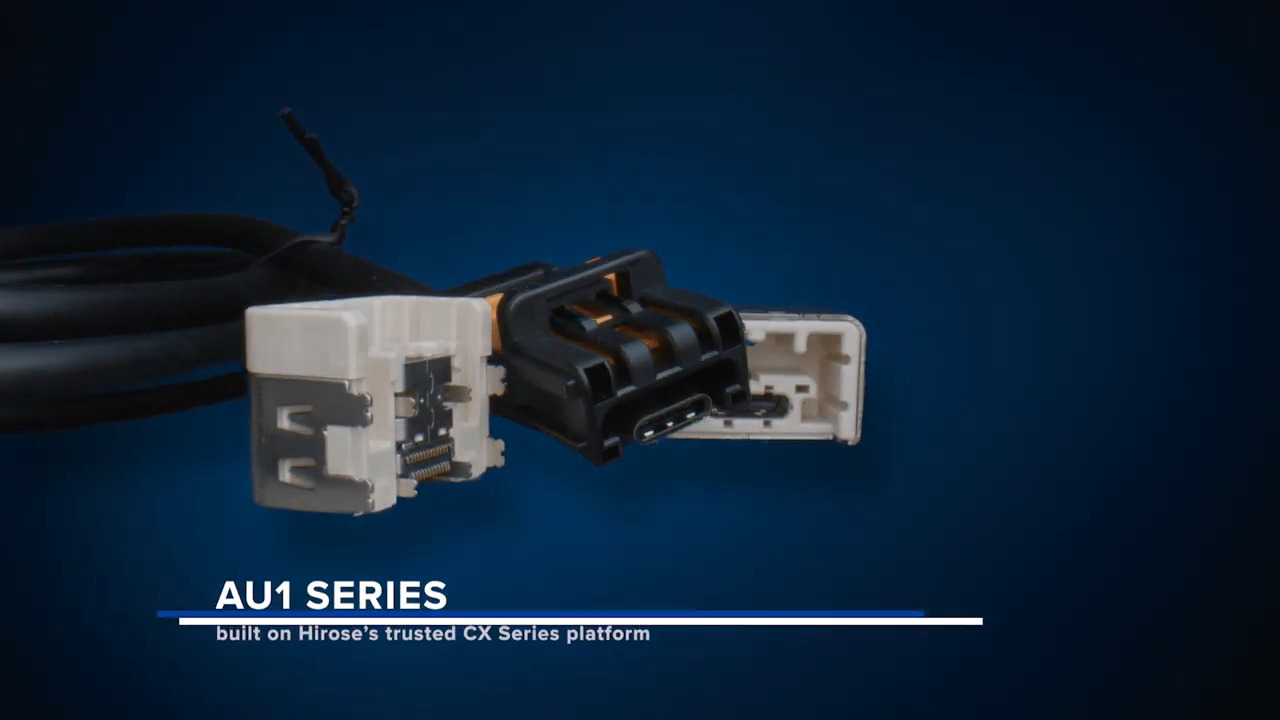
Responding to the need for suitable connectors, Hirose has introduced the AU1 series of USB-C connectors that meet the unique requirements of the automotive environment. The connectors in this series serve as a bridge between internal and external device connections, supporting standards such as USB 3.2 Gen2, DisplayPort 1.4, and HDMI. They are built and work seamlessly with the existing Hirose CX series as a foundation (Figure 1).

Image of Hirose automotive-compatible USB-C connectorsFigure 1: The AU1 series of automotive-compatible USB-C connectors (bottom) uses the CX series (top) as its building block. (Image source: Hirose)

This innovative combination enables consistent high-speed data transfers of 20 Gbits/s (USB 3.2 Gen 2×2), power levels of 240 W (USB Power Delivery 3.1 Extended Power Range (48 V, 5 A)), and reliable connectivity across the entire infotainment system, supporting advanced features and seamless system integration.

The connectors in the AU1 series deliver secure mating, resistance to vibration and heat, and reliable performance in demanding environments. By doing so, the series enables the use of this popular connector type in a much more challenging environment than the one for which it was originally intended.

Connector assemblies in this series support straight and right-angle orientations (Figure 2). This provides designers with flexibility in cable routing within the tightly constrained automotive environment.

Image of Hirose AU1 series connectors support straight and right-angle arrangements (click to enlarge)Figure 2: The AU1 series connectors support straight and right-angle arrangements; a demonstration board shows the connectors in use. (Image source: Hirose)

Ensuring secure, accurate, and correct mating

These connectors feature unique characteristics, including a Connector Position Assurance (CPA) unit and keying. The CPA unit supports secure and accurate mating. Its finger-operated latch (Figure 3) provides a secure mechanical pairing and emits an audible click, confirming to the user that the latching action was successful.

Image of Hirose CPA unit ensures that the mating connector is fully engagedFigure 3: The CPA unit ensures that the mating connector is fully engaged, then locked and held in place, until it is deliberately disengaged. (Image source: Hirose)

In operation, the CPA unit cannot move until mating is completed. Once the plug is fully engaged, the receptacle pushes down on the CPA unit, moving it into the locked position, which indicates that it is engaged as intended. To unmate, the user pulls the CPA unit to release the secondary lock; a click can be felt upon release.

If there is any axial or radial misalignment, the halves will not click, alerting the user of an incorrect mating. These connectors are rated for over 10,000 mating cycles, well beyond any anticipated use in the automotive environment.

Keying helps prevent mating the wrong cable with the target mating half. As mentioned, one of the convenient characteristics of consumer USB-C cables is that they are reversible. This also means that they have no keying or way of physically identifying which plug end goes to which receptacle. No keying is a benefit in the “just grab a cable” plug/unplug world of consumer applications. However, automotive applications are more likely to be “plug and leave alone” situations, and there is a risk of miswiring when installing dense automotive cable harnesses. In these cases, such mispairing can lead to frustration due to a non-functioning link, possible damage to the peripherals, and a potential hazard to the system and user.

To prevent miswiring, the AU1 series of automotive-grade USB-C connectors supports two types of physical-interference key codes: a standard code (black) and an “A key” code (gray/natural) (Figure 4). These two key arrangements help ensure that, in the case of two adjacent cables and connectors, incorrect pairings are physically impossible. The color differences also help identify the two key codes.

Image of mechanical keying arrangementsFigure 4: Users can use one of two mechanical keying arrangements to minimize cable-connection errors; connectors with a standard key are black, while those with an “A key” are gray (male)/natural (female). (Image source: Hirose)

Standards and electrical performance

Numbers define the environmental and electrical capabilities of these Hirose connectors. On the environmental side, they operate over a temperature range of -40°C to +105°C. Furthermore, they are waterproof and dustproof, with IP54, IP68, or IP69K ratings, depending on the connector type. IP69K is the most stringent of the three against dust and water ingress.

The connectors are compliant with the United States Council for Automotive Research (USCAR)-2 and USCAR-30 standards for assured reliability. USCAR-2 is a performance standard for automotive electrical connector systems, outlining requirements for terminals, connectors, and components in low-voltage road vehicle applications. USCAR-30 is a performance specification for automotive USB connection systems, covering the requirements for USB connectors, cables, and the electrical connection between consumer peripherals and a USB computer source in vehicles.

Electrically, their power pins (A4/A9/B4/B9 (VBUS)) are rated at 1.25 A in accordance with the USB-C specification, while the non-power pins are rated at 0.25 A, all at 20 VAC and VDC. The initial contact resistance is 40 mΩ maximum, rising slightly to no more than 50 mΩ after a series of stress tests defined by the standards.

Specifying and assembling the AU1 connector

A simple connector, such as the standard consumer AC-line plug, comes complete and ready to use in most cases, with no user-specified components. However, a sophisticated interconnect such as the AU1 connector comprises many individual parts (Figure 5). The designer can custom-order some of these parts to match the application requirements.

Image of complete Hirose AU1 connector assemblyFigure 5: The parts of the complete AU1 connector assembly include: 1) USB-C plug; 2) circuit board; 3) wire holder; 4) cable; 5) shield 1; 6) shield 2; 7) inner mold; 8) over mold; 9) housing and CPA; and 10) retainer. (Image source: Hirose)

Figure 6 shows some of the components that the user can specify. These include (top row, left to right):

  • The AU1MS-24S-SLDA(805) connector shield
  • The AU1MS-24RS(805) connector retainer
  • The AU1MS-24S-HU/C(805) latch-lock housing and CPA for a plug with a black standard key (or the AU1MSA-24S-HU/C(805) latch-lock housing and CPA with a grey A key), along with a retainer, shield case, and plug unit
  • The CX60-24S1-UNIT straddle-mount plug connector inside unit, also available as a separate item for designers needing additional plug units

A plug is only half the connector story, as there must be a matching receptacle. For the Hirose USB-C connectors, designers can select between these two versions (Figure 6, bottom row, left to right):

  • The AU1FS-24P(805) through-hole, straight USB-C receptacle connector for attaching to a printed circuit board (pc board)
  • The AU1FRA-24P(805) right-angle receptacle connector

Image of complete Hirose AU1 connector assemblyFigure 6: Some of the connector components that users can specify include (top row, left to right) the AU1MS-24S-SLDA(805) connector shield, the AU1MS-24RS(805) connector retainer, the AU1MS-24S-HU/C(805) latch-lock housing and CPA for a plug with a black standard key, and the CX60-24S1-UNIT straddle-mount plug connector; receptacle options include (bottom row, left to right) the AU1FS-24P(805) through-hole, straight USB-C receptacle and the AU1FRA-24P(805) right-angle receptacle. (Image source: Hirose)

Conclusion

The USB-C connector offers desirable performance attributes in terms of usability, speed, and power handling. However, the basic consumer-oriented connector is not mechanically suitable for automotive designs. The AU1 series connector utilizes Hirose’s established CX Series as a foundation to create a rugged, high-performance Type-C connector suitable for automotive applications that meets relevant industry specifications and standards.

DigiKey logo

免责声明:各个作者和/或论坛参与者在本网站发表的观点、看法和意见不代表 DigiKey 的观点、看法和意见,也不代表 DigiKey 官方政策。

关于此作者

Image of Bill Schweber

Bill Schweber

Bill Schweber 是一名电子工程师,撰写了三本关于电子通信系统的教科书,以及数百篇技术文章、意见专栏和产品特性说明。他担任过 EE Times 的多个特定主题网站的技术管理员,以及 EDN 的执行编辑和模拟技术编辑。

在 Analog Devices, Inc.(模拟和混合信号 IC 的领先供应商)工作期间,Bill 从事营销传播(公共关系),对技术公关职能的两个方面均很熟悉,即向媒体展示公司产品、业务事例并发布消息,同时接收此类信息。

担任 Analog 营销传播职位之前,Bill 在该公司颇受推崇的技术期刊担任副主编,并且还在公司的产品营销和应用工程部门工作过。在此之前,Bill 曾在 Instron Corp. 工作,从事材料测试机器控制的实际模拟和电源电路设计及系统集成。

他拥有电气工程硕士学位(马萨诸塞州立大学)和电气工程学士学位(哥伦比亚大学),是注册专业工程师,并持有高级业余无线电许可证。Bill 还规划、撰写并讲授了关于各种工程主题的在线课程,包括 MOSFET 基础知识、ADC 选择和驱动 LED。

关于此出版商

DigiKey 北美编辑