






 设置
设置
 快速交货
快速交货
 免运费
免运费
 国际贸易术语
 支付类型
支付类型


 市场产品
市场产品

GaN Captures the Spotlight at IMS2012
投稿人:DigiKey
2012-10-11
This year’s International Microwave Symposium (IMS2012) was held at the Palais des Congres in Montréal, Quebec, Canada. More than 7,600 microwave and RF designers, researchers, developers, academics, executives and exhibitor staff attended the conference. A record 1,225 paper submissions from 49 different countries were received and the event welcomed 569 exhibitors from 21 countries, showcasing their products and technologies.
At this year’s IMS2012, there was a higher emphasis on GaN technology compared to IMS2011. Among the companies showing GaN products for the first time was Freescale, which is known mostly for its LDMOS RF parts. Attendees saw switches and LNAs based on GaN, and modeling and testing tools were introduced that were aimed at high-power GaN devices. Even though GaN has been recognized as a compelling alternative to silicon for many RF applications because of its performance benefits, it has faced significant challenges related to cost. Those companies pushing GaN expect prices will fall as production volumes grow and the technology adapts to more applications.
Below is a sample of some important GaN-related papers presented during the technical sessions of the Symposium:
Sumitomo Electric Device Innovations (Yamanashi-Plant, Japan) presented a paper titled ‘A 2.6 GHz band 537 W peak power GaN HEMT asymmetric Doherty amplifier with 48 percent drain efficiency at 7 dB’. Currently, Doherty amplifiers are used in basestation transmitter system (BTS) since the peak-to-average power ratio of modern digital wireless communication signals, like W-CDMA, LTE and WiMAX, is around 6 to 8 dB. Additionally, Doherty amplifiers are suitable to operate in such back-off output power regions. Si-LDMOS transistors have been the dominant technology for BTS applications because of their price/performance benefits. On the other hand, GaN HEMT features high output impedance and operates with high power and high efficiency due to its high current density and high breakdown voltage. Industry analysts see GaN-HEMT gradually penetrating the high frequency BTS market.
The paper discussed the development of a 537 W saturation output power (Psat) asymmetric Doherty amplifier for the 2.6 GHz band in which the main and peak amplifiers were implemented with Psat of 210 W and 320 W GaN HEMTs (Figure 1). The newly developed 320 W GaN HEMT consists of a single GaN die, both input and output partial match networks, and a compact package.
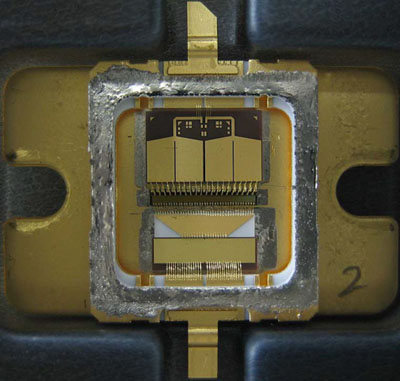
Figure 1: Top view of assembled 320-W GaN HEMT.
Its output matching network was tuned to inverse class F, and the single-ended 320 W GaN HEMT was capable of achieving a drain efficiency of greater than 61.8% from 2.4 to 2.7 GHz. The 210/320 W GaN HEMTs asymmetric Doherty amplifier achieved 57.3 dBm (537 W) Psat and 48% drain efficiency with -50.6 dBc ACLR at 50.3 dBm (107 W) average output power using a 4-carrier W-CDMA signal and a commercial digital pre-distortion system. The results confirmed good suitability for 2.6 GHz band basestations.
Another GaN related paper was presented by the Army Research Laboratory (Adelphi, MD) and was titled ‘Improved linearity of power amplifier GaN MMIC for Ka-band SATCOM’. The paper described the linearity performance of a Ka-band power amplifier (PA) GaN MMIC with a novel, balanced 4-way combiner and a built-in linearity improvement mechanism.
The use of GaN technology at mmW frequencies has increased in the past few years, seen in devices with record power densities, high-performance MMICs with bandwidths of 1 to 5 GHz and 2 to 20 GHz, high power, and high levels of integration. Because of this performance, GaN technology is being considered for many applications in which linearity and efficiency are critical. Recent efforts have focused on improving linearity and efficiency of GaN amplifiers. One of the challenges in PA design is how to achieve linearity without degrading efficiency. In this paper, the 32 to 38 GHz two-stage PA (Fig. 2) provides a power of 6 W maximum for a class-A bias. Improved linearity is accomplished by biasing the first and second stages in deep class AB and class A, respectively. Overall improvement in linearity resulted as the gain expansion of the first stage was balanced by the gain compression of the second stage.
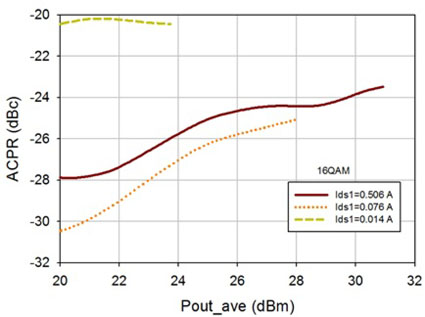
Figure 2: Measured ACPR of the amplifier for different biases of the first-stage drain current.
At another technical session, HRL Laboratories (Malibu, CA) presented its findings in a paper titled ‘92-96 GHz GaN power amplifiers’.
New advancements in GaN HEMT technology have allowed the study of high-power broadband solid-state power amplifiers at W-band, which promises to enable the next generation of high data rate W-band communication systems, phased array radars, and active imagers. The improvement of output power (Pout) over competing GaAs and InP technologies can increase operating range, reduce the antenna gain requirement, offer more linear PAs at backed-off power levels, or a combination of the above.
The paper demonstrated results of 92 to 96 GHz GaN PAs with increasing gate peripheries (150 µm to 1,200 µm). The 1,200 µm, 3-stage PA delivered an output power of 2.138 W with a PAE of 19% at 93.5 GHz (VD=14V). In the 92 to 96 GHz bandwidth, the amplifier offered over 1.5 W of Pout with associated PAE of greater than 17.8%. The results showed that the maximum Pout scales linearly with increasing gate periphery at an almost constant PAE around 20% (Figure 3).

The MMIC performances report showed how superior GaN technology can be over other solid-state technologies for W-band high power applications. The authors also noted from the study of the various size MMICs that efficient power combining can be performed on-wafer and high-power single chip PAs are possible with GaN technology.
Among currently available products for ultra-broadband amplifiers, fiber drivers, and test Instrumentation is the 2 W, 20 MHz to 6,000 MHz CMPA0060002F GaN MMIC power amplifiers from Cree. This MMIC employs a distributed (traveling-wave) amplifier design approach, enabling extremely wide bandwidths to be achieved in a small footprint screw-down package featuring a copper-tungsten heatsink.
In regards to competing GaAs solutions, check out Avago’s MGA-81563 amplifier. The part is an economical, easy-to-use GaAs MMIC amplifier that offers excellent power and low noise figure for applications from 0.1 to 6 GHz.
Next year’s IMS symposium will be in Seattle (June 2-7, 2013). If you are an RF or microwave design engineer, you should make every effort to get to the show.

免责声明:各个作者和/或论坛参与者在本网站发表的观点、看法和意见不代表 DigiKey 的观点、看法和意见,也不代表 DigiKey 官方政策。








 新加坡
新加坡